

STUDY & RESEARCH OPPORTUNITIES
Level: PhD
Abstract:
Small-scale magnetic fields in the solar photosphere play a fundamental role in the storage, redistribution, and transport of magnetic energy into the upper layers of the solar atmosphere. Although particularly abundant in the quiet Sun, these magnetic structures are also intrinsically linked to active regions and large-scale magnetic configurations.
This PhD project aims to provide a comprehensive investigation of magnetic energy storage and transport processes in the solar photosphere, with emphasis on both quiet-Sun and weakly active regions. The study will focus on quantifying key derived physical parameters, including magnetic energy density, magnetic flux distribution, and associated energy transfer proxies.
High-resolution spectropolarimetric observations, complemented by advanced inversion techniques and state-of-the-art radiative magnetohydrodynamic (MHD) simulations and data-driven modeling approaches, will be employed to accurately infer magnetic field vector properties and compute corresponding energy densities.
A key innovative aspect of this project lies in the integration of high-resolution spectropolarimetric inversions with data-driven MHD simulations and machine learning-assisted feature detection techniques to characterize magnetic energy transport across multiple spatial and temporal scales.
Requirements:
The student should be familiarized with computer software and programming language. A background in theoretical physics and various techniques of data analysis including spectropolarimetric methods, numerical modeling (particularly MHD simulations), and experience with scientific computing environments (e.g., Python, IDL, or similar platforms) will be highly advantageous.
Duration: 4 Years
Contact:
Negessa T. Shukure (PhD)
Telephone: +251910145236
E-mail: nagessa.tilahun@aau.edu.et / nagessa2006@gmail.com
Level: PhD
Abstract:
Solar surface magnetic flux density is a fundamental parameter governing solar activity across both short and long temporal scales. Variations in the Sun’s photospheric magnetic field drive a wide range of dynamic phenomena, including sunspots, coronal holes, solar flares, and solar wind structures.
This project aims to systematically quantify the relationship between solar surface magnetic flux density and key space weather indicators including sunspot characteristics, coronal hole properties, solar wind parameters, and solar flare occurrence rates and intensities.
Using observational data combined with advanced statistical techniques such as time-series analysis, cross-correlation, causal inference methods, wavelet analysis, and machine learning-assisted modeling approaches, the study will investigate how variations in magnetic flux density modulate solar eruptive events and heliospheric conditions over multiple solar cycles.
The project seeks to establish predictive relationships linking photospheric magnetic flux to diverse space weather outputs and contribute toward operational forecasting systems.
Requirements:
The student should be familiarized with computer software and programming language. A background in theoretical physics and data analysis including image processing is required; experience with time-series analysis, statistical modeling, and machine learning techniques will be considered a strong advantage.
Duration: 4 Years
Contact:
Negessa T. Shukure (PhD)
Telephone: +251910145236
E-mail: nagessa.tilahun@aau.edu.et / nagessa2006@gmail.com
Level: PhD
Abstract:
Magnetic reconnection at the magnetopause and magnetotail represents a fundamental process that governs the transfer of mass, momentum, and energy into Earth’s magnetosphere.
At low latitudes, this energy transfer mechanism is closely associated with the nonlinear phase of the Kelvin–Helmholtz (KH) instability. The KH instability facilitates plasma mixing across velocity shear boundaries, influencing both mass and energy transport at the magnetospheric interface.
This project uses spacecraft missions including ACE, Geotail, and ARTEMIS together with nonlinear theoretical models to quantitatively investigate plasma mixing across magnetosheath–magnetosphere boundary layers and examine the occurrence rate of KH instability at lunar distances.
Required Skills:
Master’s degree in space physics or astrophysics with a strong background in plasma theory. Experience with programming (Python and C++) and numerical simulations is an asset.
Interested applicants should send curriculum vitae, including a publication list if applicable and a research plan (maximum two pages).
Duration: 4 Years
Contact:
Dr. Ephrem Tesfaye
Email: ephrem.tesfaye@aau.edu.et
Level: PhD
Abstract:
Geomagnetically induced currents (GICs) are electrical currents driven in ground-based conducting systems by rapid changes in the geomagnetic field during space weather events. They are recognized as a serious hazard to power transmission infrastructure, capable of damaging transformers and disrupting grid operations.
While the impacts of GICs at high latitudes are well documented, their occurrence and characteristics in low-latitude and equatorial regions remain poorly understood. This gap is especially significant in Africa, where observational data and modeling studies are still limited despite the continent’s growing dependence on electrical infrastructure.
This project investigates the occurrence, magnitude, and frequency of GICs capable of compromising power transmission systems across low-latitude African regions. The study will utilize ground-based magnetometer observations, including the Entoto magnetic observatory, together with satellite magnetic measurements and available transmission line GIC recordings.
Numerical modeling and electromagnetic induction approaches will be used to estimate GIC amplitudes and assess hazard levels under varying space weather conditions. The findings are expected to provide the first systematic assessment of GIC hazards in the African low-latitude sector and contribute toward global space weather forecasting frameworks.
Requirements:
Applicants should have a background in physics, geophysics, space physics, or electrical engineering, with skills in scientific programming (preferably Python) and experience in data analysis. Familiarity with geomagnetic or space weather datasets is an advantage.
Duration: 4 Years
Contact:
Dr. Nigussie Mezgebe Giday
Space and Planetary Science Division, Space Science and Geospatial Institute
Email: nmezgebe1@gmail.com | nigussie.mezgeb@ssgi.gov.et
Level: PhD
Abstract:
This dissertation develops a novel AI-driven regional model to quantify vertical coupling mechanisms in the East African atmosphere–ionosphere–thermosphere system.
Persistent tropospheric convection, complex topography, and proximity to the equatorial ionization anomaly crests generate upward-propagating waves that influence the upper atmosphere from below, while solar and geomagnetic forcing simultaneously affect the system from above.
Integrating multi-source observations including reanalysis products, satellite measurements, East African ground-based instruments, and solar and geomagnetic indices across Solar Cycles 24–25, the project will employ machine learning architectures combining recurrent neural networks and convolutional layers to predict upper atmospheric states.
Explainable AI techniques such as SHAP and attention mechanisms will be used to quantify the relative contributions of bottom-up and top-down drivers, identify upward-propagating wave modes, and reveal nonlinear interactions that vary with solar cycle.
The expected outcomes include an open-source AI-driven regional model, a quantitative attribution framework, and a catalog of vertical coupling mechanisms that support satellite drag prediction, trans-equatorial communication reliability, and space weather capacity building in East Africa.
Requirements:
Interested applicants should send a curriculum vitae, including a publication list if applicable and a research plan (maximum two pages).
Duration: 4 Years
Contact:
Dr. Endalkachew Mengistu
Email: 2fendalk@gmail.com; endalkachew.mengistu@aau.edu.et
Level: MSc
Abstract:
Solar flares are among the most energetic explosive events in the solar atmosphere, releasing intense bursts of electromagnetic radiation that drive ionospheric disturbances, radio blackouts, and satellite drag — posing serious risks to navigation systems, communication infrastructure, and space-based technologies.
Accurate forecasting of solar flare occurrence remains one of the most pressing open problems in space weather science due to the complex and nonlinear evolution of solar magnetic fields preceding flare events.
This project aims to develop a solar flare prediction model integrating multi-source observational inputs including solar magnetic field parameters, extreme ultraviolet flux measurements, and X-ray flux time series to construct richer and more physically meaningful feature sets.
Machine learning architectures will be trained and validated on data spanning Solar Cycles 23, 24, and 25 to evaluate model generalizability across varying solar activity levels and improve data-driven space weather forecasting capabilities.
Requirements:
Applicants should have a background in physics, space physics, computer science, or data science, with proficiency in Python and familiarity with machine learning frameworks. Experience with solar or space weather datasets is an advantage.
Duration: 2 Years
Contact:
Dr. Nigussie Mezgebe Giday
Space and Planetary Science Division, Space Science and Geospatial Institute
Email: nmezgebe1@gmail.com | nigussie.mezgeb@ssgi.gov.et
Level: MSc
Abstract:
This research project aims to develop and validate an AI-assisted geomagnetic nowcasting and early warning system tailored to Ethiopia.
The system addresses geomagnetic disturbances influenced by the equatorial electrojet (EEJ), prompt penetration electric fields (PPEFs), disturbance dynamo electric fields (DDEFs), and ionospheric irregularities, all of which can impact power systems, GNSS-dependent services, aviation, and telecommunications.
Historical magnetometer datasets from the AMBER station in Adigrat and the INTERMAGNET observatory in Addis Ababa, together with solar wind measurements, geomagnetic indices, and GNSS-derived TEC data, will be used to train machine learning and deep learning models.
Models such as LSTM networks, GRUs, Transformer architectures, and physics-informed neural networks (PINNs) will nowcast geomagnetic disturbances and assess potential GIC risks under Ethiopian conditions.
The project establishes a foundation for future operational space weather services in Ethiopia and contributes toward improved regional forecasting and early warning capabilities.
Requirements:
Interested applicants should send curriculum vitae, including a publication list if applicable and a research plan (maximum two pages).
Duration: 2 Years
Contact:
Dr. Endalkachew Mengistu
Email: 2fendalk@gmail.com; endalkachew.mengistu@aau.edu.et
Level: MSc
Abstract:
This project investigates ionospheric disturbances triggered by intense geomagnetic storms in the equatorial and low-latitude East African sector during Solar Cycles 24 and 25.
Using GNSS-derived vertical Total Electron Content (vTEC) observations, ionosonde data, and empirical climatologies such as IRI-2020 and AfriTEC, the study examines variations in ionospheric parameters including vTEC, Equatorial Ionization Anomaly structure, F2-layer critical frequency, and plasma irregularities.
Particular emphasis is placed on longitudinal dependencies, positive and negative storm phases, seasonal modulations, and comparative analyses between solar cycles.
The project aims to improve scientific understanding of equatorial ionospheric dynamics under extreme geomagnetic forcing and contribute to enhanced GNSS reliability, HF communication resilience, and space weather forecasting capabilities in East Africa.
Requirements:
Interested applicants should send curriculum vitae, including a publication list if applicable and a research plan (maximum two pages).
Duration: 2 Years
Contact:
Dr. Endalkachew Mengistu
Email: 2fendalk@gmail.com; endalkachew.mengistu@aau.edu.et
Level: MSc
Abstract:
Small-scale magnetic fields in the quiet solar photosphere are believed to store and channel significant magnetic energy into the upper layers of the solar atmosphere. Although weaker than those in active regions, these magnetic structures play an important role in energy redistribution and may contribute to atmospheric heating and the initiation of dynamic solar phenomena.
This project aims to investigate the physical properties of small-scale magnetic fields in the quiet Sun, with particular emphasis on magnetic energy density and its contribution to vertical energy transport.
Using high-resolution observational data and advanced analysis techniques, the study will estimate magnetic flux density and compute associated energy densities. Statistical and spatial analyses will then be performed to characterize the distribution, variability, and energy transport potential of these magnetic elements.
The findings are expected to improve understanding of how magnetic energy is stored and redistributed in quiet regions of the Sun, contributing to broader knowledge of photospheric energy balance, upper atmospheric coupling, and space weather phenomena.
Requirements:
Applicants should have familiarity with computer software and programming languages, as well as a background in theoretical physics and data analysis.
Research Specialization: Solar Astrophysics and Data Analysis Techniques.
Duration: 2 Years
Contact:
Negessa T. Shukure (PhD)
Telephone: +251910145236
Email: nagessa.tilahun@aau.edu.et
Alternative Email: nagessa2006@gmail.com
Abstract:
Turbulence, a fascinating and ever-present feature of low-viscosity fluids, is key to moving energy from vast scales down to the tiniest structures in space plasmas. While scientists have odeling much about this process in the solar wind, the mysteries of turbulence within coronal mass ejection (CME) plasma remain largely unsolved. Unlike the steady flow of the solar wind, CMEs burst forth from the Sun in dramatic, isolated eruptions. In this project, you will delve into the turbulent nature of CMEs and uncover how they compare to that of the solar wind. You will have the opportunity to work with groundbreaking data from the Parker Solar Probe and Solar Orbiter, both now venturing closer to the Sun than ever before. Depending on your interests, the project can blend data analysis with theory or focus on odeling and theoretical exploration.
Supervisor:will be jointly supervised by HA Lawal, PhD ,and Dr J.O. Alao
Duration: 2 Years
Contact:
Prof. Hammed Adeniyi Lawal
Department of Land & Spatial Sciences
Namibia University of Science & Technology
Email: h.lawal@afit.edu.ng / haderesearch@gmail.com
Abstract:
Accurate prediction of terrestrial magnetic field variations is essential for understanding space weather phenomena and mitigating their impact on technological systems. This research proposes an AI-enhanced digital twin modeling framework for predicting terrestrial magnetic field variations. The digital twin integrates physics-based magnetic field models with machine learning algorithms for improved predictive accuracy. The framework simulates magnetic field behavior and updates predictions based on historical and real-time datasets. This study emphasizes modeling, algorithm development, and system validation through data analysis. The proposed approach advances digital twin applications in space and terrestrial physics research.
Supervisor:This student project will be jointly supervised by HA Lawal, PhD, and Dr. K.O. Shobowale
Duration: 2 Years
Contact:
Prof. Hammed Adeniyi Lawal
Department of Land & Spatial Sciences
Namibia University of Science & Technology
Email: h.lawal@afit.edu.ng / haderesearch@gmail.com
Abstract:
Solar eclipses provide opportunities to observe transient ionospheric behaviour. In this study, you will use dual-frequency GPS/GNSS data from regional networks to quantify the reduction in electron density during a specific solar eclipse. The analysis examines the delay between maximum optical obscuration and the lowest total electron content (TEC) to clarify the F-region's photochemical response time. These findings aim to improve plasma redistribution models.
Supervisor:This student project will be jointly supervised by HA Lawal, PhD, and Dr. Abigail Abenu
Duration: 2 years
Contact:
Prof. Hammed Adeniyi Lawal
Department of Land & Spatial Sciences
Namibia University of Science & Technology
Email: h.lawal@afit.edu.ng / haderesearch@gmail.com
Level: PhD
Abstract:
Current structure formation models invoke feedback processes to explain, for example, the observed number density of galaxies as a function of stellar mass and redshift. Understanding how these feedback processes are regulated is therefore essential to our understanding of how galaxies and large- scale structures form and evolve over cosmic time. While AGN feedback is believed to dominate in high-mass systems, stellar feedback regulates evolution in lower-mass, star-forming systems. The precise coupling of AGN energy to the interstellar medium (ISM), particularly in transitional systems, however, remains poorly understood. The Galaxy And Mass Assembly (GAMA) survey, with its deep optical spectroscopy and ancillary data in equatorial and southern regions, offers an ideal, high-completeness sample (up to z < 0.5) to study these processes over the past 5 Gyr of cosmic time. In this PhD project, the student will exploit new datasets from SKA precursor (ASKAP and MeerKAT) and pathfinder (LOFAR) instruments for the GAMA equatorial fields. The goal is to quantify the relative contributions of AGN feedback and stellar feedback (supernovae, stellar winds, etc.) in regulating star formation across different galaxy types and environments. When combined with the wealth of existing/archival multi-wavelength datasets, we can further constrain the physical mechanisms — such as ionized gas outflows and radio-mode heating — that drive the co-evolution of galaxies and supermassive black holes. The student will join a team of international collaboration working on AGN Populations in Large Unified Surveys (A-PLUS) and the Evolutionary Map of the Universe (EMU).
Additional Notes:
• This student project will be jointly supervised by Dr. Saul Paul Phiri (Copperbelt University, Zambia), Dr. Emmanuel Manful-Bempong(University of Manchester, UK), and Prof. Andrew Hopkins (Macquarie University, Australia).
• The position is fully funded for 3 years, and the successful candidate is expected to start in September/October 2026.
• The student will be based at Copperbelt University, Zambia but will have the opportunity to undertake research visits to Manchester and Macquarie.
Duration: 3 Years
Contact:
Dr. Saul Paul Phiri
Copperbelt University
Department of Physics
Email: saulphiri@gmail.com / saul.phiri@cbu.ac.zm
Level: PhD
Abstract:
These fibrils are identified from the 1.3 mm continuum emission in the ALMA-QUARKS survey, which has a linear resolution of 900 AU for a source at 3 kpc, using the FilFinder software. Using RadFil software, we find that the typical width of these fibrils is \( \lt 0.01 \) pc, which is about ten times narrower than that of dusty filaments in nearby clouds identified by the Herschel Space Observatory. The mass (\( M \)) versus length (\( L \)) relation for these fibrils follows \( M \propto L^2 \), like that of Galactic filaments identified in space (e.g., Herschel) and ground-based single-dish (e.g., APEX) surveys. However, these fibrils are significantly denser (\( N_\mathrm{H_2} = 10^{23} - 10^{24} \, \mathrm{cm^{-2}} \)) than the filaments found in previous Herschel surveys (\( N_\mathrm{H_2} = 10^{22} - 10^{23} \, \mathrm{cm^{-2}} \)). This work contributes a large sample of superfine fibrils in massive clumps, following the identification of large 0.1 pc wide filaments and associated internal velocity coherent fibers in nearby molecular clouds, further emphasizing the crucial role played by filamentary structures in star formation at various physical scales. Are the sub-structures in fibrils? Observing nearby galactic star forming regions like Orion would help us answer that question.
Additional Notes:
• This student project will be jointly supervised by Dr. Saul Paul Phiri (Copperbelt University, Zambia) and Prof. James Okwe Chibueze (University of South Africa , SA), Dr. Joseph Simfumkwe (Copperbelt University)
• The position is fully funded for 3 years, and the successful candidate is expected to start in September/October 2026.
• The student will be based at Copperbelt University, Zambia but will have the opportunity to undertake research visits to UNISA - South Africa.
Duration: 3 Years
Contact:
Dr. Saul Paul Phiri
Copperbelt University
Department of Physics
Email: saulphiri@gmail.com / saul.phiri@cbu.ac.zm
Level: PhD
Abstract:
The origin of the stellar initial mass function (IMF) has been one of the most fundamental unsolved problems in astrophysics for seventy years. Since Salpeter's seminal discovery in 1955, we have known how stars are distributed by mass, but we have never understood why. Equally puzzling is the origin of binary star systems, which comprise more than half of all solar-type stars and over 80% of massive stars. Despite decades of observational advances and theoretical effort, no existing model—whether turbulent fragmentation or competitive accretion—has provided a complete, first-principles explanation for either phenomenon, let alone both.
This project will conduct the first rigorous, comprehensive investigation into a provocative alternative proposed by Nyambuya (2026a,b,c), which suggests that both the IMF and the properties of binary star systems can be explained by a single, unified geometric mechanism: two-scale gravitational fragmentation. The central hypothesis is that a molecular cloud near the Jeans limit, with a centrally concentrated density profile, fragments on two characteristic scales simultaneously. The central region collapses first, generating an outward-propagating compression wave that triggers fragmentation in concentric shells. This geometry yields a power-law Core Mass Function (CMF) which, through a core-star relation derived from radiation-hydrodynamic equilibrium, maps directly to the observed stellar IMF. The same geometry naturally explains the formation of binary stars via the competition between a core's own center of mass and the global cloud center—a mechanism that uniquely predicts the observed "twin excess" (a sharp peak at mass ratio q ∼ 1) and a radial multiplicity gradient in star clusters.
The theoretical foundation of the model is provided by the Azimuthally Symmetric Theory of Gravitation (ASTG-model; Nyambuya 2010, 2026c), which extends Newtonian gravity to incorporate the spin of a gravitating body. Remarkably, the theory contains no free parameters; the fine structure constant α0 ≈ 1/137 appears in the gravitational potential, suggesting a deep connection between star formation and quantum gravity.
The model makes several testable predictions: (1) cores should be arranged in concentric shells at discrete radii; (2) stars in outer shells should be systematically younger than those in inner shells; (3) the IMF slope should be linearly related to the CMF slope (Γimf = 1 + 2.76(Γcmf − 1)); (4) binary mass ratios should be flat for q < 0.95 with a sharp twin excess at q ∼ 1; and (5) binary fraction should increase with distance from the cluster center. These predictions can be tested with high-resolution observations from ALMA, JWST, and GAIA—making this one of the most falsifiable theories of star formation ever proposed.
Duration: 3 years
Contact:
Prof. G. G. Nyambuya
Department of Applied Physics
Copperbelt University / University of Science and Technology
Email: golden.nyambuya@nust.ac.zw
Level: MSc
Abstract:
Radio continuum emission at ~1.4 GHz is widely employed as a dust-insensitive tracer of star formation rate (SFR) and forms a key science driver for current and forthcoming deep radio surveys.
However, the extent to which radio luminosity alone permits accurate, deterministic SFR inference across different environments and luminosity regimes remains uncertain.
We reassess the radio-SFR connection using deep multi-wavelength data for field galaxies from the VLA-COSMOS survey and cluster galaxies from the MeerKAT Galaxy Cluster Legacy Survey, spanning \( 0 < z \lesssim 6.5 \).
Infrared-derived SFRs are adopted as independent reference measurements.
Using a suite of linear and non-linear regression models trained on radio-only inputs, we quantify the recoverable variance in SFR.
Across all models, predictive performance saturates at \( R^2 \sim 0.40-0.45 \) in log-space, indicating that more than half of the intrinsic variance in SFR is not encoded in 1.4 GHz luminosity alone.
The empirical radio-SFR relation is systematically sub-linear, implying luminosity-dependent biases if proportional calibrations are assumed.
Masking independently identified AGN or moderate radio-excess sources does not restore a tight or linear relation.
These results suggest that the dominant scatter in the radio-SFR relation is physical rather than methodological.
While radio emission remains a valuable tracer of star-forming activity, robust SFR inference in the MeerKAT and Square Kilometre Array era will require multi-wavelength or probabilistic approaches that account for intrinsic scatter and environmental modulation.
In this project, the relationship between star formation rate estimated from HI gas would be compared to the radio continuum fluxes.
Additional Notes:
•This student project will be jointly supervised by Dr. Saul Paul Phiri (Copperbelt University, Zambia) and Prof. James Okwe Chibueze (University of South Africa , SA)
• The position is fully funded for 2 years, and the successful candidate is expected to start in September/October 2026.
• The student will be based at Copperbelt University, Zambia but will have the opportunity to undertake research visits to UNISA - South Africa.
Duration: 2 Years
Contact:
Dr. Saul Paul Phiri
Copperbelt University
Department of Physics
Email: saulphiri@gmail.com / saul.phiri@cbu.ac.zm
Programme: Master of Philosophy (Geology)
Programme Duration: 2 Years
Project Abstract:
The significance of lithium (Li) in modern applications, such as lithium battery production for electric
vehicles, and various manufacturing processes, has led to its increasing demand and intensified search
for more and new economically viable deposits across the globe (Ettehadi et al., 2024; He et al., 2025).
According to Kesler (2012), the Li supply to meet this estimated demand will come largely from
pegmatite and related magmatic deposits, evaporative brines, and a growing group of unusual deposits
including both rocks and brines.
In Southern Zambia, several exploration works have highlighted the potential for pegmatite-hosted Li.
This study explores the use of integrated multi-source remote sensing data and machine learning to
improve lithium exploration in Southern Zambia. It will combine multispectral and hyperspectral
satellite imagery with geological and geospatial datasets to identify anomalous targets of lithium
mineralization, vis-à-vis lithological variations, structural features, and alteration signatures.
Proposed Methodology
In this study, the lithological and structural fault information will be obtained using the
median-resolution remote-sensing image Landsat-8, the radar image Sentinel-1 and hyperspectral data GF-5.
Using Landsat-8 data, alteration zones closely related to pegmatites in the region will be mapped out by
principal component analysis, pseudo-anomaly processing and other suitable methods. High spatial
resolution remote-sensing data WorldView-2 and WorldView-3 short-wave infrared images will be used
and analyzed by principal component analysis (PCA), the band ratio method and multi-class machine
learning (ML). This will be integrated with conventional threshold-specified algorithms used to
automatically extract Li-bearing pegmatite information.
Field investigations will verify the geology of the pegmatites, coupled with mineralogical and
geochemical analysis. Finally, the Li-bearing pegmatites will be delineated, based on a comprehensive
analysis of the lithology, structures, alteration zones and Li-bearing pegmatite geology/geochemistry.
Expected Outcomes
This research is expected to aid large-scale lithium exploration by delineating exploration targets for
otherwise inaccessible areas. Several studies have highlighted that multi-source remote sensing and
machine learning have great potential for the identification of Li-bearing pegmatites similar to those
found in Southern Zambia.
Qualifications/Attributes of Potential Students
Potential applicants for this study must have a Bachelors Degree in Geosciences with a merit or better,
and added knowledge of GIS, Remote Sensing and Machine Learning.
Supervisors:
Dr. Gabriel Ziwa, AFHEA
Contact:
Dr. Gabriel Ziwa, AFHEA
Head of Department – Geology
Copperbelt University
Email: gabriel.ziwa@cbu.ac.zm or gabriel.ziwa@gmail.com
Mobile/WhatsApp: +260 966 598 974
Level: MSc
Abstract:
Active galaxies, which host an active galactic nuclei (AGN) at their centre, are some of the fundamental types of galaxies, important for understanding galaxy formation and evolution. However, the role of AGN and star formation in galaxy evolution, as well as the connection between AGN and their host galaxies, and the feeding and feedback processes of AGN, remain unclear. The impact of AGN on other physical properties of their hosts and vice versa, such as star formation, stellar populations, metallicity or morphology, remains an open question. For example, previous studies suggest the existence of both a negative feedback, which quenches star formation and contributes to older stellar populations, and a positive AGN feedback, which enhances star formation and gives a higher fraction of younger stellar populations. The interaction between AGN and star formation is still unclear and detailed studies are needed to fully understand the mechanisms involved. Furthermore, how star formation quenching occurs in AGN host galaxies, whether inside-out, outside-in, or mixed, remains understudied and unclear. Integral field spectroscopy (IFS) data are a powerful tool for studying the spatial distribution of galaxy properties, AGN-star formation interplay, and the relation between AGN and their host galaxies. In addition, studying how galaxies form and evolve in different environments (e.g., field, groups and clusters) provides important information for modern cosmology. This project aims to select a large sample of AGN in galaxy clusters observed with the Hubble Space Telescope and with the VLT/MUSE and SALT/SMI-200 IFS instruments, to study in detail the AGN-star formation interplay across the galaxy (from galaxy centers to outskirts), through measured emission line ratios and AGN activity, star formation rates, stellar populations, and quenching mechanisms, in relation to cluster properties, such as clustercentric distance, local density, and cluster mass. The thesis will provide the student with the opportunity to go beyond the current state-of-the-art in our understanding of the connection between AGN and host galaxies in different environments, using some of the best IFS data available and preparing for the major IFS studies to come with next-generation telescopes, such as the E-ELT.
Supervisors:
Saul Paul Phiri (Copperbelt University, Zambia)
Mirjana Povic (Instituto de Astrofisica de Andalucia (CSIC), Spain, and Space Science and Geospatial Institute, Ethiopia)
Roberto de Propris (Botswana International University of Science and Technology, Botswana, and University of Turku, Finland)
Antoine Mahoro (South African Astronomical Observatory, South Africa)
Duration: 2 years
Contact:
Dr. Saul Paul Phiri
Copperbelt University
Department of Physics
Email: saulphiri@gmail.com / saul.phiri@cbu.ac.zm
Level: MSc
Abstract:
Active Galactic Nuclei (AGNs) exhibit diverse observational properties largely explained by orientation-based unification schemes. Among radio-loud AGNs, low-luminosity sources—BL Lacertae objects (BL Lacs) and Fanaroff–Riley Type I (FRI) radio galaxies—are hypothesized to form a unified class, with BL Lacs representing the beamed, pole-on counterparts of the unbeamed FRI parent population. However, the relationship between radio-selected BL Lacs (RBLs), X-ray-selected BL Lacs (XBLs), and FRI galaxies remains unclear, particularly whether the two BL Lac subclasses are intrinsically distinct or represent extremes of a continuous distribution. This study will statistically test the unification hypothesis for low-luminosity AGNs using a sample of RBLs, XBLs, and FRI galaxies with observational data at 1.5 GHz and 5 GHz compiled from the literature. Key beaming and orientation parameters—core luminosity (L_C), extended luminosity (L_E), core-dominance parameter (R), and viewing angle (phi)—will be analyzed using distribution statistics, correlation analysis, and comparative ratio methods under continuous jet (n = 2) and blob (n = 3) models. The findings will clarify the BL Lac–FRI unification paradigm and reveal distinctions between RBLs and XBLs, reinforcing that while all three classes share a common parent population, relativistic beaming and orientation determine their observational classification.
Duration: 2 years
Contact:
Dr. Godson Abbey
Copperbelt University
Department of Physics
Email: godsonabbey88@gmail.com
Level: MSc
Abstract:
Galaxy surveys give us information about the distribution of galaxies in the Universe and
the galaxy distribution contains information about the initial conditions of the Universe.
One of the most important signatures we can search for is primordial non-Gaussianity
(PNG), which arises from the physics of inflation in the very early Universe. Measur-
ing PNG can give vital information about inflationary models and discriminate between
different theories of the early Universe.
This project will investigate the observational signatures of primordial non-Gaussianity in
galaxy surveys, focusing on how it affects the galaxy distribution through scale-dependent
bias and how current and future surveys can constrain PNG. The project involves both
theoretical and computational work. With guidance and support, you will explore prop-
erties of the galaxy distribution, including the galaxy power spectrum, and investigate
the effects of local non-Gaussianity (fNL) on large-scale structure.
Particular attention will be given to the unique advantages of HI intensity mapping with
SKA for probing ultra-large scales where PNG signatures are strongest, as well as the
multi-tracer technique which uses multiple galaxy populations to reduce cosmic variance
and improve constraints on fNL. Students will learn Fisher forecast techniques for con-
straining fNL parameters and assessing the constraining power of different survey config-
urations.
Key aspects to explore include: the statistical properties of primordial density fluctua-
tions, scale-dependent bias as a signature of local-type PNG. The project will examine
current observational constraints, and future prospects with Dark Energy Survey Instru-
ment (DESI), Euclid Telescope, Large Legacy Survey of Space and Time (LSST), and
Square Kilometre Array (SKA).
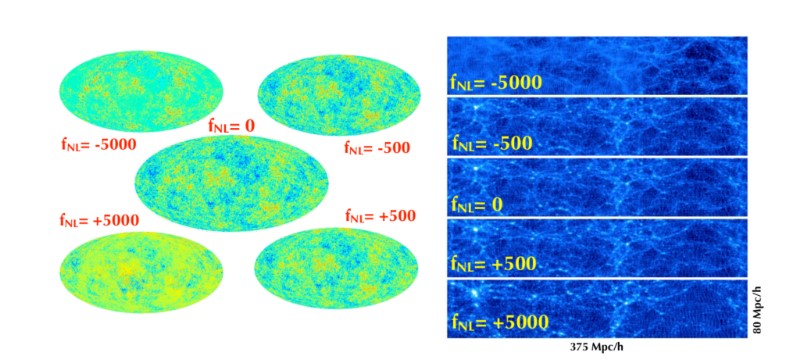
Figure 1: Illustration of the effects of primordial non-Gaussianity on cosmic structure. Left: CMB temperature fluctuations for different values of fNL. Right: Large-scale struc- ture distribution in a 375 × 80 Mpc/h slice showing how different fNL values affect the clustering of matter. Non-zero fNL modifies the statistical properties of density fluctua- tions, leading to observable signatures in both the CMB and galaxy distribution.
Supervisors:
Dr. Simthembile Dlamini, University of Cape Town
Dr. Saul Phiri, Copperbelt University
Duration: 2 years
Contact:
Dr. Saul Paul Phiri
Copperbelt University
Department of Physics
Email: saulphiri@gmail.com / saul.phiri@cbu.ac.zm
Abstract:
GNSS broadcast ephemerides provide satellite orbits accurate to within a range of one to several meters. This broadcast orbit information is sufficient for standard positioning but inadequate for decimeter-level applications such as surveying and precision agriculture. Accessing precise orbit products requires internet connectivity and processing latency that many users in resource-constrained regions cannot afford.
The aim of this study is to develop a post-processing algorithm that estimates radial, along-track, and cross- track (RTN) orbit corrections directly from broadcast ephemerides using regional CORS network observations within a Kalman filter or batch least-squares framework. Validated through simulation with synthetically degraded orbits across multiple constellations, the algorithm targets few-decimeter orbit recovery while systematically characterizing the network geometry, observation span, and regularization conditions governing identifiability.
Duration: 2 years
Contact:
Dr. Joseph Odumosu
jodumodu@nust.na
Abstract:
Desertification in northern Namibia provides an excellent terrestrial analogue for understanding active surface modification processes on Mars. This research will analyse long-term vegetation dynamics, surface albedo changes, and land degradation patterns using multi-decadal Landsat imagery, Sentinel 2 data, and MODIS time series. Vegetation indices, bare-soil indices, land surface temperatures, and dust source indicators will be generated and examined using trend analysis and change-detection techniques. Rainfall data will be incorporated to evaluate climate driven variability. The spatial patterns of degradation and sediment redistribution will be compared with mapped Martian dust transport pathways and surface alteration zones. The study will produce a detailed assessment of the rate, extent, and drivers of desertification and will
demonstrate how Earth observation time series can be used to interpret planetary surface evolution. The outcomes will support both sustainable land management in Namibia and comparative planetary geomorphology.
Duration: 2 Years
Contact:
Prof. Oluibukun Ajayi
Department of Land & Spatial Sciences
Namibia University of Science & Technology
Email: oajayi@nust.na
Abstract:
Soil moisture is a key parameter for agricultural productivity and is also critical for future
extraterrestrial food production systems. This project will retrieve and analyse soil moisture patterns across semi arid Namibia using Sentinel 1 SAR backscatter, coarse resolution SMAP or SMOS soil moisture products, and thermal data from Landsat. Optical indices will be used to downscale coarse products to field-relevant resolution. The LST NDVI feature space approach and change detection techniques will be implemented to derive high-resolution soil moisture maps. Validation will be carried out using rainfall data and available ground observations. The spatial variability of soil moisture under extreme climatic conditions will be assessed to identify environments that simulate controlled agriculture constraints expected in lunar and Martian habitats.
The research will generate a scalable methodology for soil moisture retrieval in data scarce regions and provide insights for both precision agriculture in Namibia and space-based life support system planning.
Duration: 2 Years
Contact:
Prof. Oluibukun Ajayi
Department of Land & Spatial Sciences
Namibia University of Science & Technology
Email: oajayi@nust.na
Abstract:
Hydrothermal alteration minerals are key indicators of past fluid activity and potential habitability on Mars. This research will use spaceborne hyperspectral data, supported by ASTERSWIR, to map alteration minerals in selected Namibian terrains. Preprocessing will include atmospheric correction and noise reduction, followed by spectral matching techniques such as spectral angle mapper and matched filtering. Alteration minerals including clays, iron oxides, and sulphates will be identified and their spatial distribution analysed in relation to geological structures. Spectral signatures will be compared with Martian mineral libraries derived from orbital spectrometers. The study will produce high-resolution mineral distribution maps and demonstrate how terrestrial hyperspectral analysis can support the interpretation of planetary aqueous environments.
Duration: 2 Years
Contact:
Prof. Oluibukun Ajayi
Department of Land & Spatial Sciences
Namibia University of Science & Technology
Email: oajayi@nust.na
Level: MSc
Supervisor:
Dr. Steven Mudenda
Abstract:
The rapid expansion of solar photovoltaic (PV) systems across Africa has created an
urgent need for reliable methods to monitor installation quality, performance, and
spatial distribution. However, many countries lack comprehensive databases on the
orientation, inclination, and operational efficiency of installed solar panels,
particularly in distributed rooftop systems. These parameters are critical determinants
of energy yield and system reliability.
Zambia’s recent load-shedding crisis spurred widespread rooftop solar adoption,
prompting the government to waive import duties on solar equipment. Many
households installed (and more are installing) panels without professional guidance,
resulting in misorientations and reduced output.
This work will develop an automated methodology for detecting panel installation,
tilt, orientation (azimuth) and potential power output and losses due to
misalignments using satellite remote sensing data combined with machine learning
techniques. Ground measurements will be collected for a subset of PV installations
for validation and model calibration.
The project will use High-Resolution Satellite Imagery or LiDAR as source data.
The study will integrate image processing, geospatial analysis, and solar energy
modelling to infer panel geometry from imagery and assess its impact on expected
energy production. The resulting framework will support improved planning,
monitoring, and optimisation of solar energy systems in urban and peri-urban
environments.
This project will survey a Lusaka neighbourhood and results have potential to be
scaled to the entire country in urban and peri-urban environments.
The project will provide the student with interdisciplinary training in the use of space
technology such as remote sensing in renewable energy systems to contribute to the
development of digital tools for sustainable energy planning in Africa.
In summary, this project aims to develop tools to determine national solar PV
inventory, urban solar potential estimation and detection of poorly oriented
installations.
Duration: 2 Years
Contact:
Dr. Steven Mudenda
University of Zambia
Physics Department
Email: steven.mudenda@unza.ac.zm
Level: MSc
Abstract:
The ionospheric scale height (H) at the F2 peak, obtained from the bottomside electron density profile via an α-Chapman formulation, is a key parameter representing the “puffiness” of the upper atmosphere. It is essential for accurate satellite drag modelling, GNSS ionospheric corrections, and topside profile reconstruction. To date, the only African-sector analysis of this parameter was performed over the mid-latitude station Grahamstown, South Africa (33.3°S, 26.5°E) using Digisonde ionograms from 2002–2004 (Nambala et al., 2008). That study revealed pronounced diurnal and seasonal variations and a strong correlation between H, the IRI shape parameter (B0), and the peak electron density (NmF2).
This MSc research replicates and extends the original methodology to the low-latitude/equatorial sector over Lusaka, Zambia (15.4°S, 28.3°E). Because no permanent ionosonde operates in Zambia, the project would employ the latest International Reference Ionosphere (IRI-2016) model and the physics-based SAMI2 model (via the open-source Pyglow library) to generate synthetic electron density profiles at Lusaka coordinates. The effective scale height H would then be extracted using the same α-Chapman fitting approach employed in the Grahamstown Digisonde ARTIST software. The resulting Lusaka-specific H climatology would improve orbital-decay predictions for Zambian CubeSat missions and enhance positioning, navigation and timing (PNT) accuracy for regional aviation and surveying.
Model outputs would be validated against (i) available GIRO/DIDBase ionosonde data from the nearest African stations (e.g., the SANSA network in South Africa) to compare mid- and low-latitude behaviour and (ii) local GNSS TEC observations from UNZA and IGS receivers.
The student will be supervised by Dr. Fred Joe Nambala.
Duration: 2 years
Supervisor:
Fred Joe Nambala
Contact:
Dr. Fred Joe Nambala
University of Zambia
Physics Department
Email: fred.nambala@unza.zm
Level: MSc
Abstract:
Merging galaxy clusters host Mpc-scale, highly polarized and elongated radio relics, illuminated by cosmic ray electrons (CRe) accelerated by shock waves. The origin of these energetic electrons is still unclear. There is convincing evidence that radio relics trace merger-induced shock waves in the intracluster medium. However, an understanding of the origin of radio relics remains sketchy. The successful model that explains the formation of the relics is known as Diffuse Shock Acceleration (DSA). Although several studies show that many relics agree with DSA, recent studies have discovered some relics with lower luminosity that differ from this model. Their X-ray Mach number indicates weak shocks that cannot form such relics according to the DSA. It is unclear what mechanism is behind the birth of these underluminous relics. This research investigates the spectral indices and curvatures of the double underluminous radio relics in Abell 2108 between the frequencies 132-250 MHz in Low-Frequency Array (LOFAR) and 250-500 MHz in the upgraded Giant Meterwave Radio Telescope (uGMRT). When spectral index maps for the two pairs of frequencies are obtained and examined, the spectral index trends for these relics can be studied in detail.
The student will be supervised by Dr. Cosmo Dumba.
Supervisor: Dr. Cosmo Dumba
Duration: 2 years
Contact:
Dr. Cosmo Dumba
University of Zambia
Physics Department
Email: cosmos.dumba@gmail.com
Level: PhD
Abstract:
Cosmic-ray, neutrino, and gravitational wave detectors have ushered in the golden age of multi-messenger astrophysics. Both ultra-high energy cosmic ray (UHECR) detectors and neutrino detectors have begun to detect significant anisotropies in their angular distribution. In the case of the Pierre Auger cosmic ray observatory and the IceCube neutrino observatory, the highest significance positions in the northern sky, while below the threshold for being considered a detection, are coincident with galaxies that display both starburst (high star formation) and AGN-driven (Seyferts, evidence for jets) activity; NGC 4945 in the case of Auger, and NGC 1068 in the case of IceCube. Both UHECRs and neutrinos can be considered evidence of acceleration of protons, which can occur through both starburst and AGN-driven processes.
Wits is a member of both the next generation very high-energy gamma-ray telescope, the Cherenkov Telescope Array (CTA) consortium, and a next-generation neutrino observatory, KM3NeT. Taking advantage of the accumulated experience in multiwavelength and multi-messenger astrophysics and access to CTA and KM3Net development, this PhD project will be to develop models of hadronic emission in starburst/Seyfert galaxies to determine a) whether they can explain the UHECR and neutrino observations and b) whether they will produce detectable emission in next-generation instruments, including CTA and KM3NeT.
Duration: 3 years
Contact:
Prof. Andrew Chen
andrew.chen@wits.ac.za
Wits Centre for Astrophysics
University of the Witwatersrand
Johannesburg
South Africa
Level: PhD
Abstract:
Galaxy clusters are the most massive gravitationally collapsed structures in the universe, with masses ~100 trillion times that of the Sun. By counting the number of massive clusters that we find in the universe as a function of redshift, and therefore measuring the rate at which they grow, we can place constraints on cosmological parameters. In this project we will contribute to the search for galaxy clusters being conducted by the Simons Observatory (https://simonsobservatory.org/) by developing processing pipelines for confirming clusters and measuring their redshifts from optical data obtained by the Rubin Observatory (https://rubinobservatory.org/). The student will also lead some other aspect of the scientific analysis using this cluster sample. This could be related to the properties of the galaxies within the clusters ; the intracluster light ; or the evolution of the hot gas atmospheres of the clusters.
Duration: 3 years
Contact:
Prof. Matt Hilton
matt.hilton@wits.ac.za
Johannesburg
South Africa
Level: PhD
Abstract:
EMPOWER (Emission line Mapping of the galaxy POpulation in the cosmic WEb Environments; PI: Paola Popesso) is a new ESO survey project being conducted with the KMOS instrument at the VLT. The first observations to be obtained cover the massive z ~ 0.8 galaxy clusters ACT-CL J0528 and J0022. We will use the EMPOWER data to investigate star formation, via Halpha emission maps, as a function of local galaxy environment and clustercentric radius. Since these are among the most massive clusters known at this redshift, the ram pressure due to the intracluster medium is expected to be high, and we expect to see signatures of stripping in the Halpha emission maps of individual cluster galaxies. We may also compare SFR and AGN diagnostics as measured with EMPOWER with other tracers available for these clusters (e.g., from far-IR and radio data). The student will be expected to contribute to pipeline processing of the EMPOWER data to produce spectral data cubes and emission maps, as well as leading the analysis for this specific project.
Duration: 3 years
Contact:
Prof. Matt Hilton
matt.hilton@wits.ac.za
University of the Witwatersrand
Johannesburg
South Africa
Abstract:
The Astronomical Plate Archive of the South African Sky, comprising dozens of historically important photographic plates taken at the Johannesburg Observatory dating back to 1909, is now based in the School of Physics at Wits. In order to maximise the potential of this invaluable data archive for scientific research, the contents of the plates must be digitised and rendered into a modern, open data format accessible to scientists worldwide.
Wits has begun the process of producing calibrated digital photographs of the plates and digitising the contents of the associated log books. What is needed is an automated process that can transform the digitised contents of the plates and log books into data formatted with astronomically relevant metadata and images compatible with resources such as the Virtual Observatory and other scientific open access databases. This MSc project will be to research the appropriate data format and algorithms and to develop and deploy the automated process that will transform the raw data of the digitised plate archive into a valuable and globally accessible resource for astronomical research
Duration: 2 years
Contact:
Prof. Andrew Chen
andrew.chen@wits.ac.za
Wits Centre for Astrophysics
University of the Witwatersrand
Johannesburg
South Africa
Level: MSc
Abstract:
The nature of dark matter remains one of the central problems in modern particle physics. Abundant evidence exists for particle dark matter, yet we know nothing about the particle’s nature. One method of searching for this is with radio telescopes. How can we see something dark with a radio, you ask? We hope to see radio waves emitted when dark matter decays or annihilates. For WIMP dark matter these would come from electrons emitting synchrotron radiation in magnetised cosmic environments. Axions, on the other hand, can decay or transform into radio photons under the right conditions. In all cases we can compare observations with MeerKAT, from archival data, to theoretical predictions and put limits on what dark matter is allowed to be. If we don’t discover it, we can at least determine what it isn’t. This would be the main project for an MSc enrolled at the University of the Witwatersrand
supervised by Dr Geoff Beck. Students undertaking this project would become familiar with analysis of MeerKAT data, predicting indirect dark matter signatures, and the statistical comparison of theory and data.
Supervisor: Dr. Geoffrey Beck
Duration: 2 years
Contact:
Contact: Dr Geoffrey Beck
geoffrey.beck@wits.ac.za
University of the Witwatersrand
Johannesburg
South Africa